Dental Prosthetics
Chew well again, speak with confidence and feel like yourself.
At Clínica Zaplana we offer every type of dental prosthesis: crowns, bridges, removable dentures and implant-supported prosthetics. Every case is different and each solution is designed with precision so the result is natural, functional and long-lasting.
years of experience in Valencia
in complex cases
first consultation, no commitment
payment options for you
What is a dental prosthesis and when is it needed?
When one or more teeth are lost, the problem goes beyond appearance. Missing teeth affect chewing, alter pronunciation, can cause the remaining teeth to shift and, over time, lead to a progressive loss of bone in the area. The sooner the lost tooth is replaced, the better for the rest of the mouth. Dental prosthetics are the solutions designed to replace those missing teeth, whether one, several or all of them. There are fixed, removable and implant-supported options, and the choice of one or another depends on the clinical situation of each patient, not on a price list. At our clinic, the first thing is to understand your case properly before recommending anything.
A well-made prosthesis goes unnoticed. It feels as if it had always been there.
- Every option in one place. We offer crowns, bridges, removable dentures and implant-supported prosthetics. We don’t refer you elsewhere: the diagnosis, the planning, the surgical phase if there are implants and the placement of the final prosthesis are all done here, with the same team from start to finish.
- A natural, aesthetic result. We work with high-quality materials that replicate the colour, shape and translucency of a natural tooth. The goal is for the result to be indistinguishable from the rest of your teeth. No teeth that ‘show’.
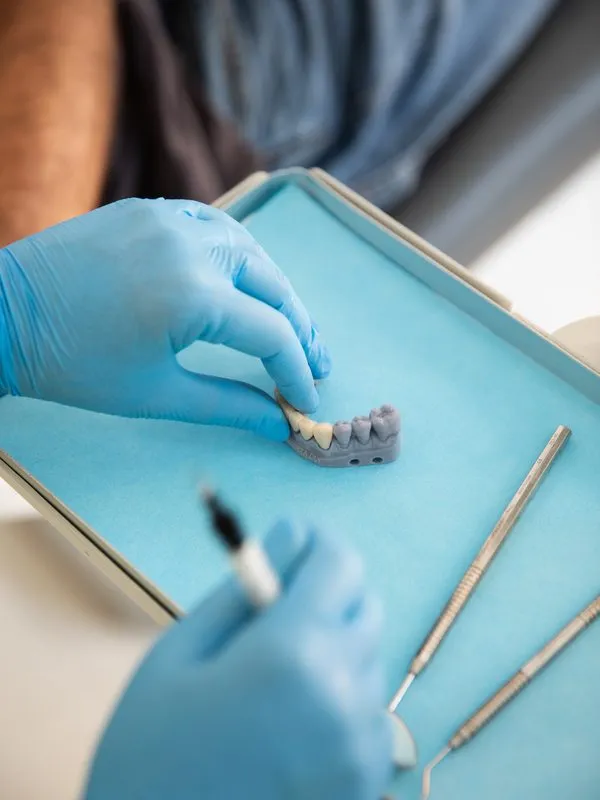
- A bespoke design for each patient. No two mouths are the same. We take precise measurements and plan each case individually. Before making the final prosthesis, we go through fitting stages to make sure the fit, the bite and the aesthetics are exactly right.
- Backed by our own diagnostic imaging. For cases that require it, we have CBCT and dental CT at the clinic itself. This lets us plan the placement of implants and the design of the prosthesis precisely before starting, with no surprises during treatment.
What types of prosthesis are there and which is right for your case?
Each solution has its own indications. Here is what we offer and the situation each option is intended for:
| Type of prosthesis | When it’s indicated |
|---|---|
| Crown | Your own tooth badly damaged, fractured or root-treated that needs covering and protecting |
| Fixed bridge | One or more missing teeth with healthy natural teeth on either side to act as support |
| Partial removable denture | Several teeth are missing but some of your own remain to anchor the prosthesis |
| Complete removable denture | Total absence of teeth in one or both jaws, when implants aren’t a viable option |
| Implant-supported prosthesis | Replacement of one or more teeth with the highest level of function and aesthetics, anchored directly to the bone |
| Implant-supported overdenture | A complete prosthesis stabilised with implants for patients without teeth who want greater security and comfort than with a conventional removable one |
What is the process from the first visit to the final prosthesis?
The number of steps varies depending on the type of prosthesis, but we always follow the same philosophy: plan well before executing, and place nothing permanent without having verified that the result is right.
- Initial assessment and diagnosis. We examine the state of your teeth, gums and bone. If necessary, we use our own diagnostic imaging technology (X-rays, CBCT or CT) to have all the information before planning. At this visit we already explain which options are viable for your case and why.
- Personalised treatment plan. We present the options, the timings and a detailed quote before starting. Nothing is done without you having understood and approved it. If any prior treatment is needed (extraction, implant, periodontal treatment), we explain that at this stage too.
- Preparation and taking measurements. We prepare the abutment teeth if necessary (shaping for crowns or bridges) or place the implants if the case requires it. We take precise measurements of your mouth so the laboratory makes the prosthesis with an exact fit.
- Fitting the prosthesis. Before cementing or fixing anything permanently, we carry out a fitting in the mouth. We check the aesthetics, the fit, the bite and the comfort. If anything isn’t exactly as it should be, it’s corrected at this stage.
- Final placement. Once we’ve confirmed everything is correct, we proceed with the final placement. We explain how to care for the prosthesis, what to expect during the first few days of adaptation and when to come back for the check-up.
- Follow-up and maintenance. Prosthetics, like natural teeth, require regular check-ups. Over time they may need small adjustments. We carry out an active follow-up so your prosthesis keeps working and looking good in the long term.
Dudas frecuentes sobre dental prosthetics
Is a removable denture the same as false teeth?
Essentially yes, although the term 'false teeth' is associated with the full dentures of old. Today there are partial removable dentures (when some teeth are missing) and complete ones (when none remain), made with materials far more modern, comfortable and aesthetic than before. They are a valid option when implants aren't possible.
How long does a dental prosthesis last?
It depends on the type and the care. Well-maintained implant-supported prosthetics can last decades. Ceramic crowns and bridges have a working life of many years if looked after properly. Removable dentures usually need adjustment or replacement sooner, because the bone and gums change over time.
Is the process painful?
No. All prosthetic procedures are carried out under local anaesthetic when necessary. The stages of taking measurements, fittings and placement are painless. If implants are involved, the recovery is manageable and we explain exactly what to expect at every moment.
Are implant-supported prosthetics better than conventional ones?
Functionally yes, because being anchored to the bone they behave almost like natural teeth: they don't move, they let you chew normally and they don't affect the neighbouring teeth. They're the option closest to having your own teeth. The difference is that they require a prior implant phase and not every case is suitable without prior treatment of the bone.
What's the difference between a crown and a bridge?
A crown covers and protects a damaged tooth that still has a root. A bridge is used when a tooth is missing: it rests on the neighbouring teeth to fill the gap. Both are fixed solutions, meaning they aren't removed. The choice depends on the state of the teeth present and the specific situation of each patient.
Our specialists in dental prosthetics
Your treatment is handled by a doctor who specializes in dental prosthetics, trained specifically in this field and ready to handle the most complex cases.
Articles about dental prosthetics
What our specialists say about this treatment.