Dental radiology in Valencia
Complete diagnostic imaging
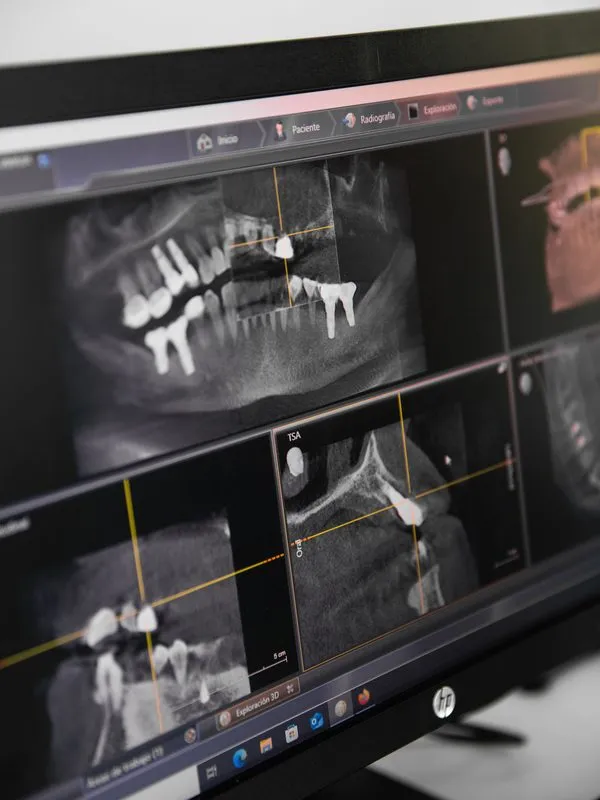
At Clínica Zaplana we have CT, CBCT, orthopantomogram, lateral cephalogram and digital periapical imaging. Every imaging test is carried out here, with low-radiation digital technology and results in the same visit.
years of experience in Valencia
in complex cases
first consultation, no commitment
payment options for you
What is dental radiology and what is it for?
Dental radiology is one of the most important diagnostic tools we have at the clinic. It lets us see what isn’t visible to the naked eye: the state of the bones, the roots, the nerves, the tissues and the internal structures of the mouth. Without that information, many treatments simply can’t be planned with precision. We don’t use imaging tests routinely or indiscriminately. We request them when we consider they are necessary for the diagnosis, so that each patient receives exactly the information their case requires. And we do it all here, at our own clinic, with no external referrals and no waiting.
All the diagnostic technology you need, in a single place
- Complete equipment at our own clinic. We have dental CT, digital periapical imaging, orthopantomogram, lateral cephalogram and CBCT. It is a set of equipment that few dental clinics in Valencia offer in full under one roof. You don’t need to go anywhere else: every imaging test is carried out here.
- Results in the same visit. With the technology in-house, our specialists work with the images right away. There’s no need to wait days for a report to arrive from outside. The diagnosis is quicker, the planning is more precise and the patient leaves the visit with all the information they need.
- Digital technology to minimise radiation. All our radiology is digital, which makes it possible to obtain high-quality images with a significantly lower radiation dose than traditional analogue systems. Patient safety is part of the diagnosis.
- Professionals with the proper qualifications. Imaging tests are carried out by the authorised professionals on our team depending on each patient’s case. Each specialist works with the diagnostic test that corresponds to their area, ensuring that interpretation and planning are done with the utmost clinical judgement.
What imaging tests do we carry out and what is each one for?
Each test has a specific purpose. Depending on what we need to see, we use one or another, or a combination of several:
| Test | What we use it for |
|---|---|
| Digital periapical | See one or several specific teeth in detail: root, surrounding bone, possible infections or fractures |
| Orthopantomogram | A panoramic view of the whole mouth: teeth, bones, joints and adjacent structures in a single image |
| Lateral cephalogram | Analysis of the relationship between the jaws and the skull, key in planning orthodontics and maxillofacial surgery |
| CBCT (Cone Beam) | A high-precision three-dimensional image, essential for planning dental implants, complex orthodontic cases and surgery |
| Dental CT | A detailed study of bone structures and tissues in cases requiring a more complete diagnostic assessment, especially in maxillofacial surgery and advanced implantology |
How do we integrate radiology into the diagnostic process?
We don’t request imaging tests as a matter of protocol. We order them when they are necessary to correctly understand what is happening to the patient and to plan the treatment precisely. The usual process is as follows:
- Prior clinical assessment. Before any imaging test, the specialist carries out a complete clinical examination. It is that assessment which determines whether we need more radiological information and, if so, what type of test adds the most value for that specific case.
- Carrying out the test at our own clinic. All radiology is done here, with our digital equipment. The patient doesn’t need to travel to any external centre. The test is done in the same visit, with the minimum waiting time.
- Immediate analysis by the specialist. As it’s digital technology integrated into our systems, the professional can review the images right away. This speeds up the diagnosis and makes it possible to explain to the patient, with the image in front of them, what we are seeing and what implications it has for their treatment.
- Integration into the treatment plan. The information obtained is incorporated directly into the planning. In treatments such as implants, orthodontics or maxillofacial surgery, the images are the basis on which the whole process is designed. A good treatment plan always starts with a good diagnosis.
Dudas frecuentes sobre dental radiology
Do I need to book a specific appointment to have an X-ray?
Not always. In many cases, the imaging test is carried out within the same assessment visit, with no need for a separate appointment. If your case allows it, we do everything in one go so you don't have to come in twice.
Is the radiation from dental tests dangerous?
No. The radiation from dental imaging tests is very low, especially with digital technology like the one we use at the clinic. To give you an idea, a dental X-ray emits a tiny fraction of the radiation we are naturally exposed to in everyday life. They are completely safe tests when indicated.
Do I need a referral to have an imaging test?
No. Any professional on our team can order the test you need depending on the case. And by carrying it out right here, the process is far quicker: in the same visit the test is done, analysed and decisions are made.
What's the difference between a CBCT and a conventional X-ray?
The main difference is the dimension. A conventional X-ray, such as the orthopantomogram, offers a 2D image. The CBCT (Cone Beam) generates a three-dimensional image that lets us see the anatomy with far greater precision: depth, bone volume, the exact position of nerves... It is essential for planning implants precisely or tackling more complex orthodontic or surgical cases.
Can I bring X-rays from another clinic?
Yes, of course. If you have recent imaging tests from another clinic, you can bring them and our specialists will assess them. Depending on how current they are and what we need to see, they may be enough or we may need to complete the study with an additional test.
Our specialists in dental radiology
Your treatment is handled by a doctor who specializes in dental radiology, trained specifically in this field and ready to handle the most complex cases.